
Key Takeaways
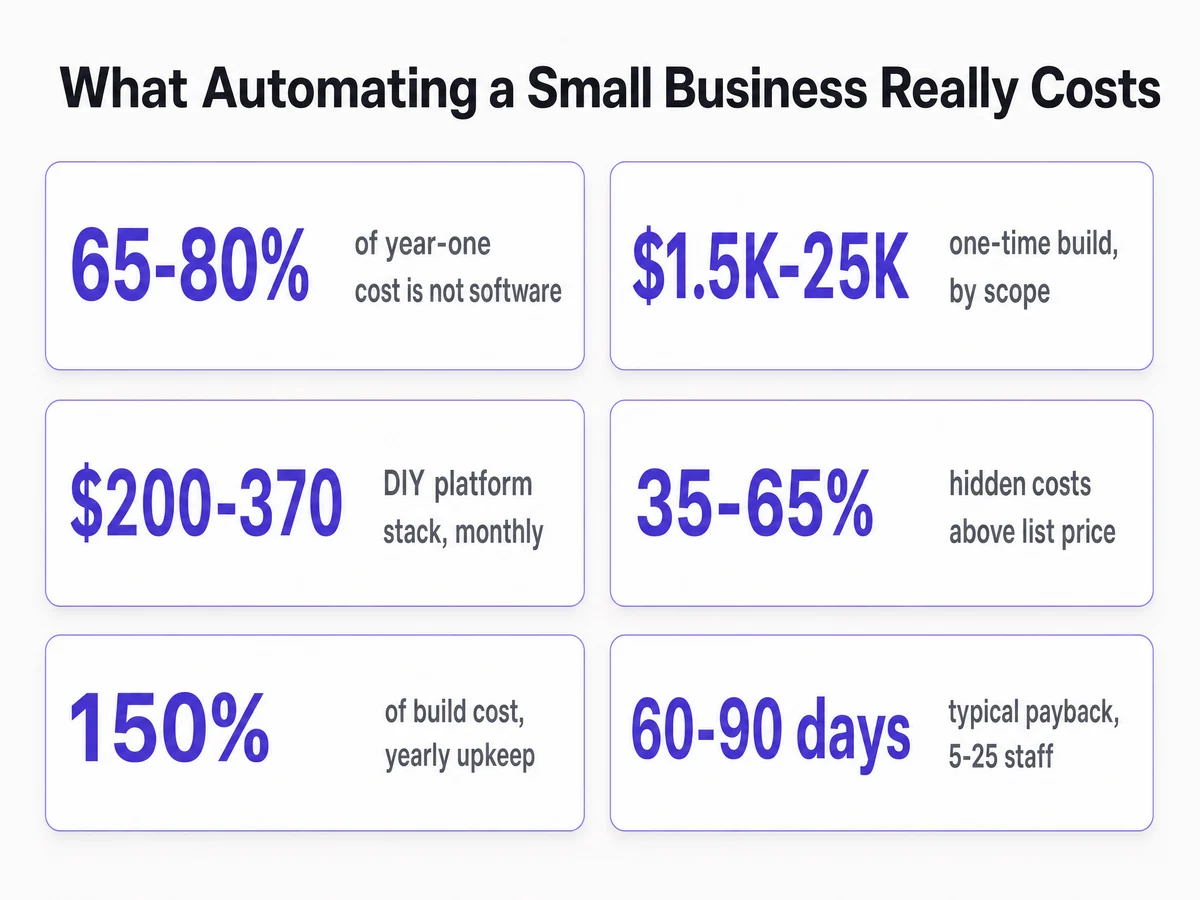
- Gartner research, cited across 2026 pricing guides, puts software at only 20–35% of total AI implementation cost — so 65 to 80% of year-one spend sits in lines no price list shows.
- One-time build fees run roughly $1,500 to $25,000 depending on scope; a single well-defined workflow from a freelancer can be $500 to $2,000.
- Running a lean DIY stack costs about $200 to $370 a month in platform fees before anyone builds anything.
- Published analyses put hidden costs — integration, training, overage, seat minimums — at 35 to 65% above advertised pricing.
- A realistic maintenance budget is significant: guides suggest planning for upkeep at a meaningful fraction of build cost every year, because connected apps change and someone has to fix it.
- Payback for well-scoped projects lands at two to six months, commonly 60 to 90 days for businesses with 5 to 25 staff. We have removed the “30 days” claim this page previously carried; we could not source it.
- The cheapest expensive mistake is paying for AI on a task a plain rule would handle.
Every pricing page for this leads with a monthly figure, because a monthly figure is easy to compare and easy to say yes to. It is also the number least likely to describe what you end up paying.
So this guide runs the other way round: the full year-one picture first, the monthly line in its proper place, and the specific line items that turn a $10,000 project into a $14,000 one.
How Much Does It Cost to Automate a Small Business?
Three numbers, and you need all three to have an answer at all.
| Component | Typical range | Notes |
|---|---|---|
| One-time build | $1,500–$25,000 | Simple workflow at the bottom, custom multi-system at the top |
| Monthly running | $200–$2,500 | Platform fees, API usage, monitoring; scales with volume |
| Maintenance | Annual, not optional | Vendors change APIs; someone has to notice and fix it |
For a small business automating one job properly — missed calls, booking, follow-up — a realistic first-year total is the build plus twelve months of running costs plus the upkeep. Published guides put year-one at roughly 1.5 to 2 times the quoted monthly subscription once implementation, integration and training are included.
Avelle's pricing
For transparency, here is ours. It is a managed model: setup, integration and support are in the monthly fee, with no separate setup charge and no lock-in term.
| Tier | What you get | Monthly | Best for |
|---|---|---|---|
| Starter | 1–2 AI agents (e.g. lead follow-up + scheduling) | $500–$800 | Solo operators, small teams |
| Growth | 3–4 agents across multiple areas | $1,000–$1,500 | 5–20 employees |
| Custom | Full deployment with custom integrations | $1,500–$2,500 | Established businesses scaling up |
What Does the Monthly Price Actually Cover?
Usually four things, and it is worth asking which of them your quote includes rather than assuming.
- Platform and licence fees — the automation tool itself, plus anything it connects to.
- Model and API usage — billed per call or per token, so it moves with your volume rather than sitting flat.
- Monitoring — somebody noticing when a run fails, which is not automatic.
- Support and fixes — the part that decides whether the thing still works in a year, covered in who maintains my AI automation after it's built.
Why Is Software the Smallest Part of the Cost?
Because buying the tool was never the hard part. Gartner research, quoted across 2026 vendor pricing guides, puts software licences at just 20 to 35% of total AI implementation cost. The remainder is implementation, integration, training and the organisational work of changing how people do a job.
What Are the Hidden Costs Nobody Quotes?
Published analyses put these at 35 to 65% above advertised pricing. The recurring offenders:
- Usage and overage. A workflow that runs thousands of times a day turns a small per-call fee into a real bill. Ask the cost per task beyond your plan limit before you sign.
- Premium connectors. Connecting to accounting or CRM systems is often a higher licence tier. Power Automate starts at $15 per user per month, but unattended bots run $150–$215 each, which changes the arithmetic entirely.
- Seat minimums. A two-person business on a five-seat minimum pays for three licences nobody uses.
- Exit costs. Some platforms charge to export your own data. Ask who owns the workflows and whether they are portable — if the logic lives inside one closed system, leaving means rebuilding.
- Your own hours. The DIY route is free in cash and expensive in time: guides estimate 40 to 80 hours for an owner configuring a full system from scratch.
What Does Each Route Cost: DIY, Freelancer or Agency?
| Route | Build | Monthly | The real trade |
|---|---|---|---|
| DIY | Your time: 40–80 hrs | $200–$370 platform fees | Cheapest in cash; maintenance lands on you |
| Freelancer | $500–$2,000 per workflow | Platform fees only | Fine for one job; no continuity when they move on |
| Agency retainer | $2,000–$12,000 setup | $1,000–$3,500 | Someone owns it; you pay for that |
| Managed (ours) | Included | $500–$2,500 | No setup fee; monthly carries the build |
Note what the setup fee does. Some agencies waive it in exchange for a minimum retainer term — that moves the cost into the monthly rate rather than removing it. Both models are legitimate; only one of them is usually explained. If you are weighing the DIY route seriously, can I build my own AI automation works through it honestly, and what an automation consultant does covers what paid help is actually for.
How Fast Does It Pay Back?
Published 2026 guides put well-scoped projects at two to six months, and businesses with 5 to 25 staff commonly at 60 to 90 days. That is a genuinely good return — and it is slower than this page used to claim.
The arithmetic is simple enough to do yourself: setup cost divided by monthly benefit minus monthly running cost. Is AI automation worth it for small business works a full example, including the part most calculators skip — freed hours only become money if somebody redeploys them.
The comparison most owners are really making is against a hire. A full-time employee costs $3,500–$6,000 a month in salary before benefits and overhead; automation runs a fraction of that but covers a fraction of the role. AI automation vs hiring has the full side-by-side.
How Do You Keep the Bill Down?
- Automate one job, not a programme. One stable, rule-based process beats a company-wide transformation, and it is the single biggest cost control available. How to pick which one is a scoring exercise.
- Do not buy AI where a rule will do. Paying model costs for something a simple condition handles is the most common way a first project overspends — the distinction is in AI agent vs automation.
- Budget a contingency. Guides suggest around 20% for integration surprises. Integrations are where estimates break.
- Write the process down first. Discovery costs less than rework, every time.
- Ask for the year-one number, not the monthly one. Any vendor who cannot produce it has not thought about your second year.
How We Sourced This
Our own pricing is first-party and published above in full. Market ranges come from 2026 pricing guides including SoluLab, Parix, Taskip and Cohevo, plus platform-specific analysis from AlphaBOLD on Power Automate licensing.
The weakness in that evidence base, stated plainly: most of these guides are published by firms selling automation services, so the ranges reflect seller positioning rather than independent survey data. The Gartner cost-split figure reaches us through those secondary sources rather than from the original report. Treat every band here as directional. Where we could not source a number we removed it, including the 30-day payback claim this page previously carried. For definitions, start with what is AI automation; for what is worth automating at all, what you can actually automate; and for the customer-retention case, AI customer retention.
Frequently Asked Questions
Budget $500 to $2,500 a month for a managed setup, plus a one-time build that published 2026 guides put between $1,500 and $25,000 depending on scope. The monthly figure is the part most quotes lead with and the smallest part of what you actually spend in year one.
For one well-scoped workflow, a realistic year-one total is the build plus twelve months of running costs plus maintenance. Published guides put year-one at roughly 1.5 to 2 times the quoted monthly subscription once implementation, integration and training are counted.
API and usage charges that scale with volume, premium connectors for systems like QuickBooks or Salesforce, seat minimums that make small teams pay for unused licences, export fees if you leave a platform, and maintenance when connected apps change. Published analyses put these at 35 to 65 percent above advertised pricing.
In cash, usually. In total, often not. Guides estimate an owner with no prior experience spends 40 to 80 hours configuring a full system, which is a real cost even though it never appears on an invoice, and the maintenance lands on whoever built it.
Published 2026 guides put well-scoped projects at two to six months, and small businesses with five to 25 staff commonly at 60 to 90 days. Treat faster claims sceptically: payback depends on how often the job happens and what one instance is worth, not on the tool.
Enough for one job done properly rather than three done partly. For most small businesses that means a single workflow, a one-time build in the low thousands, a few hundred a month to run it, and a named owner to keep it alive.
Usually yes, commonly $2,000 to $12,000 by scope. Some waive it in exchange for a minimum retainer term, which moves the cost into the monthly rate rather than removing it. Ask which of the two you are being offered.
What the cost per extra task is beyond the plan limit, what the running costs are after handover, who owns the workflows, and whether you can export them. If the logic lives inside one closed platform, leaving later means rebuilding.
Want a Year-One Number for Your Business?
Book a free 30-minute call. We will scope one job, give you the build cost, the monthly running cost and the maintenance obligation together — and tell you if the payback does not stack up.
Book Your Free AI Assessment →