
The AI Landscape Is Changing Fast
If you've used ChatGPT to write an email, asked Midjourney to generate an image, or let Grammarly fix your copy—you've used an AI tool. These applications are powerful, popular, and everywhere.
But there's a new category emerging that goes far beyond what these tools can do. It's called agentic AI—and it represents the next evolution of artificial intelligence automation. These are autonomous AI agents that can actually run parts of your business.
Understanding the difference between AI tools and agentic AI isn't just academic. It determines whether you're using AI for convenience—or using it for competitive advantage.
What Are AI Tools?
AI tools are single-purpose applications powered by artificial intelligence. You give them a prompt, they return a result. One input, one output. They're brilliant at the specific task they're designed for—but they can't think beyond it.
Examples of AI tools you probably already use:
- ChatGPT / Claude — Text generation, Q&A, summarization
- Midjourney / DALL·E — Image generation from text prompts
- Grammarly — Writing correction and tone adjustment
- Otter.ai — Meeting transcription
- Jasper / Copy.ai — Marketing copy generation
These tools are reactive. They wait for you to ask. They do one thing. Then they stop and wait again. They don't know what you did before, what you need to do next, or how their output connects to the rest of your workflow.
That's the fundamental limitation: AI tools are isolated. Each one lives in its own silo, and the human is the glue holding them together.
What Is Agentic AI?
Agentic AI is artificial intelligence that can autonomously plan, make decisions, and execute multi-step tasks without constant human input. Instead of responding to a single prompt, an AI agent takes a goal and figures out how to achieve it—breaking the work into subtasks, using multiple tools, and adapting its approach based on results.
Here's the key shift: with AI tools, you are the orchestrator. You prompt each tool, review the output, copy it to the next tool, and manage the entire chain manually. With agentic AI, the AI is the orchestrator. You set the goal. The agent handles the rest.
An agentic AI system can:
- Receive a lead inquiry via email
- Qualify the lead based on your ideal customer criteria
- Draft and send a personalized response
- Schedule a discovery call on your calendar
- Update your CRM with the lead's details and status
- Alert your sales team with a summary and recommended next steps
All of this happens autonomously. No prompting. No copying and pasting between apps. No human in the loop until a high-value decision requires one.
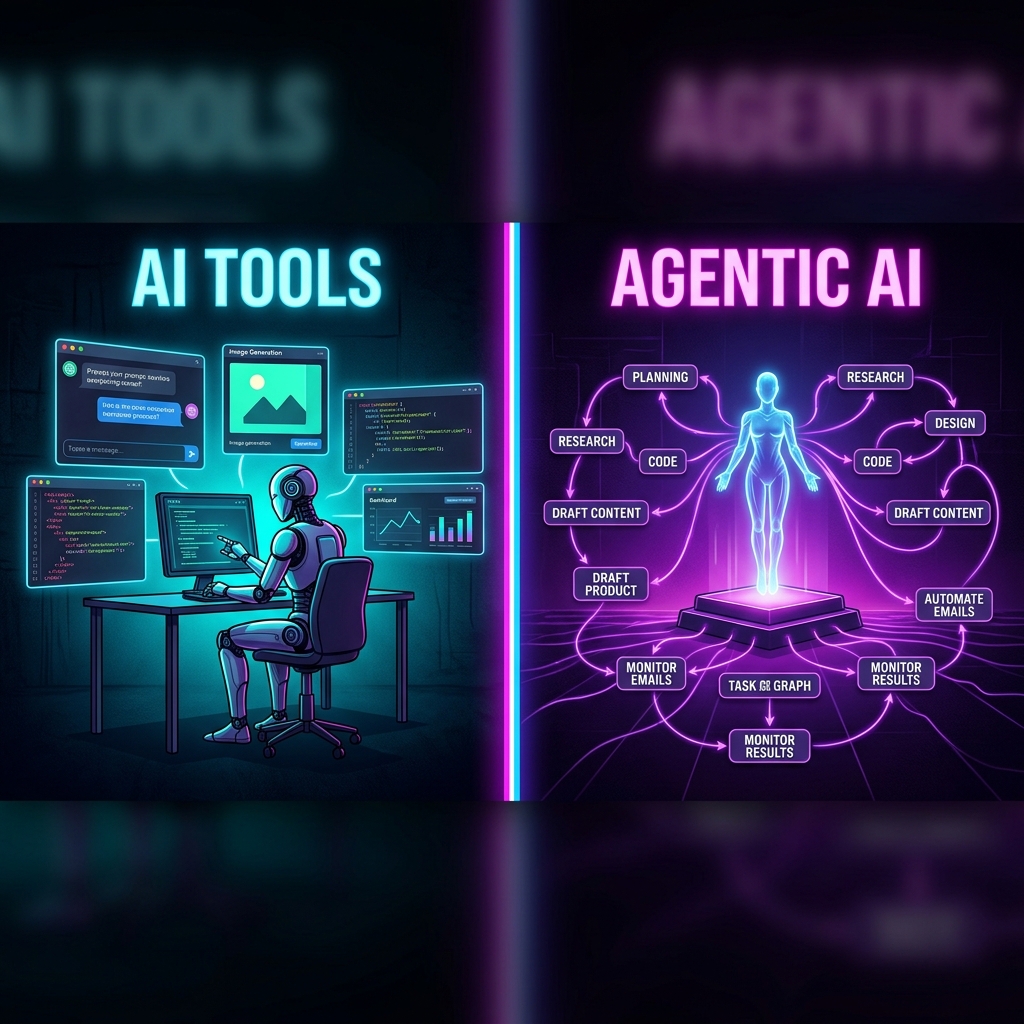
AI Tools vs Agentic AI — Side by Side
| Capability | AI Tools | Agentic AI |
|---|---|---|
| Interaction model | Single prompt → single response | Goal → autonomous multi-step execution |
| Planning | None — human decides next step | Creates and follows its own plan |
| Tool usage | One tool at a time, manually | Uses multiple tools and APIs together |
| Memory | Session-based or none | Persistent context across tasks |
| Error handling | Stops and waits for human | Adapts, retries, or escalates |
| Autonomy | Fully human-directed | Self-directed within guardrails |
| Business impact | Saves minutes per task | Saves hours per day |
| Best analogy | A calculator | A team member |
The simplest way to think about it: AI tools are like hiring a freelancer who does exactly one task when you ask. Agentic AI is like hiring a full-time employee who understands your business, knows what needs to get done, and gets it done without being told every step.
Why This Matters for Your Business
Most businesses today are stuck in what we call the "tool trap"—they've adopted five, ten, even twenty AI tools, but the human still has to connect them all. The owner or operations manager becomes the bottleneck, manually shuttling data between ChatGPT, their CRM, their email, their calendar, and their accounting software.
Agentic AI eliminates that bottleneck. Instead of using AI tools, you deploy AI agents. Each agent owns a workflow end-to-end:
- Lead Acquisition Agent — Captures, qualifies, and nurtures inbound leads 24/7
- Scheduling Agent — Handles booking, reminders, rescheduling, and no-show follow-up
- Admin Agent — Processes invoices, sorts emails, generates reports
- Retention Agent — Sends review requests, handles feedback, triggers loyalty workflows
These agents don't replace your team. They handle the repetitive, time-consuming work so your team can focus on what actually requires human judgment, creativity, and relationship-building. That's the real promise of automation and artificial intelligence working together—not replacing humans, but freeing them.
Real-World Example: AI Tools vs Agentic AI
Let's say a potential customer fills out the contact form on your website at 9 PM on a Friday.
With AI tools:
- You get a notification (maybe). You're off for the weekend.
- Monday morning, you open ChatGPT, paste the lead's info, and ask it to draft a response.
- You copy the response into Gmail, customize it, and hit send.
- You open your CRM and manually create a new contact.
- You open your calendar to offer availability. Maybe.
- Total time elapsed: 63 hours. The lead has already contacted your competitor.
With agentic AI:
- The AI agent receives the form submission instantly.
- It qualifies the lead, drafts a personalized response, and sends it within 60 seconds.
- It checks your calendar and offers three booking slots.
- It creates the contact in your CRM with a qualification score.
- It alerts you with a summary: "New qualified lead. Discovery call booked for Tuesday 2 PM."
- Total time elapsed: under 2 minutes. You didn't lift a finger.
That's not an incremental improvement. That's a completely different operating model.
By 2028, 33% of enterprise software applications will include agentic AI, up from less than 1% in 2024.
— Gartner, Top Strategic Technology Trends for 2025Frequently Asked Questions
Agentic AI is artificial intelligence that can autonomously plan, make decisions, and execute multi-step tasks without constant human input. Unlike standard AI tools that respond to a single prompt, agentic AI breaks down complex goals into subtasks, uses tools and APIs, and adapts its approach based on results.
AI tools are single-purpose applications that respond to individual prompts—like a chatbot answering a question or an image generator creating a picture. Agentic AI is an autonomous system that takes a goal, creates its own plan, executes multiple steps across different tools, and adapts in real time. The key difference is autonomy: AI tools wait for instructions, while agentic AI takes initiative.
AI agents work by connecting to your existing business tools (email, CRM, calendar, accounting) and autonomously handling multi-step workflows. For example, an AI agent can receive a lead inquiry, qualify it, send a personalized response, schedule a follow-up, and update your CRM—all without human involvement.
Standard ChatGPT is an AI tool, not agentic AI. It responds to individual prompts and doesn't take autonomous action. However, when ChatGPT is connected to plugins, APIs, and workflow engines that allow it to plan and execute multi-step tasks independently, it begins to function as an agentic AI system.
Ready to Move Beyond AI Tools?
Book a free 30-minute strategy call to see how agentic AI can automate your core workflows. No sales pitch—just clarity on where AI agents fit in your business.
Book Your Free AI Assessment →